








SME Applications of AI for Startups: Use Cases & Benefits
Explore practical SME applications of AI for Startups, including use cases in marketing, sales, operations, finance, and growth-focused automation.


Small and Medium Enterprises (SMEs) are the foundation of many economies, and startups serving this segment are constantly looking for smarter ways to grow. Artificial intelligence is emerging as a practical solution that helps SMEs operate more efficiently, control costs, and compete with larger organizations. Today, AI for Startups is no longer a futuristic concept; it is a usable, results-driven technology that addresses real operational and strategic challenges.
With limited budgets and resources, SMEs benefit from AI through task automation, data-driven decision-making, and improved business insights. When implemented thoughtfully, AI for Startups empowers SME-focused businesses to scale sustainably while maintaining efficiency, quality, and agility.
Why AI Matters for SMEs and Startups
Small and medium enterprises often struggle with limited manpower, operational inefficiencies, and rising competition. Managing multiple business functions with constrained resources can slow growth and impact decision-making. Artificial intelligence helps address these challenges by offering scalable and affordable solutions that were once available only to large enterprises. By integrating AI, SMEs can streamline operations, improve accuracy, and respond faster to market changes.
Key benefits of AI for SMEs include
-
Automation of repetitive and time-consuming tasks
-
Enhanced customer engagement and support
-
More accurate demand forecasting and planning
-
Stronger data-driven decision-making
-
Improved cost and time efficiency
For startups building solutions for SMEs, AI for Startups enables the creation of high-impact, accessible technologies that drive measurable business value.
Key SME Applications of AI for Startups
AI can be applied across multiple SME functions. Startups should focus on areas where AI delivers immediate and measurable value.
1. Customer Support and Engagement
Customer interaction is critical for SMEs. AI-powered tools help manage support efficiently without large teams.
Common AI applications include:
-
Chatbots for basic inquiries
-
Automated ticket routing
-
Sentiment analysis of customer feedback
-
Personalized responses
These tools improve response time and satisfaction, making customer service a strong use case for AI for startups.
2. Sales and Lead Management
Sales processes often involve manual follow-ups and guesswork. AI streamlines this workflow.
AI-powered sales applications include:
-
Lead scoring and prioritization
-
Sales forecasting
-
Customer behavior analysis
-
Automated follow-up reminders
These applications help SMEs close deals faster and increase revenue through AI for startups.
3. Marketing and Personalization
Marketing budgets are limited for SMEs. AI helps maximize returns through smarter targeting.
Key AI-driven marketing uses include:
-
Customer segmentation
-
Personalized email campaigns
-
Content recommendations
-
Ad performance optimization
By leveraging AI for startups, SME-focused marketing becomes more data-driven and cost-effective.
4. Operations and Process Automation
Operational efficiency is a major challenge for SMEs. AI reduces manual effort and errors.
Automation use cases include:
-
Invoice processing
-
Order management
-
Workflow automation
-
Inventory tracking
Process automation is one of the most impactful areas of AI for startups in SME environments.
5. Finance and Accounting
Financial management is critical for SME stability. AI improves accuracy and compliance.
AI applications in finance include:
-
Expense categorization
-
Cash flow forecasting
-
Fraud detection
-
Automated reporting
These applications help SMEs gain better financial control using AI for startups.
6. Supply Chain and Inventory Management
Supply chain inefficiencies directly affect SME profitability. AI helps optimize planning.
AI-driven supply chain uses include:
-
Demand forecasting
-
Inventory optimization
-
Supplier performance analysis
-
Delivery route optimization
Such applications demonstrate how AI for startups improves operational resilience.
7. Human Resources and Workforce Management
SMEs often lack dedicated HR teams. AI simplifies HR processes.
HR-related AI applications include:
-
Resume screening
-
Employee scheduling
-
Performance analysis
-
Attrition prediction
These tools allow SMEs to manage talent effectively through AI for startups.
8. Risk Management and Compliance
Regulatory compliance and risk management can overwhelm SMEs. AI offers predictive support.
AI use cases include:
-
Risk assessment models
-
Compliance monitoring
-
Anomaly detection
-
Audit preparation
Responsible risk management builds trust in AI for startup solutions.
9. Data Analytics and Business Intelligence
Many SMEs collect data but do not use it effectively. AI turns raw data into insights.
Analytics applications include:
-
Performance dashboards
-
Trend analysis
-
Predictive insights
-
Decision-support systems
Analytics-driven decision-making strengthens the business value of AI for startups.
10. Industry-Specific SME Applications
AI solutions become even more powerful when tailored to specific industries.
Examples include:
-
Retail: demand prediction and pricing optimization
-
Manufacturing: predictive maintenance
-
Healthcare SMEs: patient data analysis
-
Education SMEs: personalized learning
Industry-focused solutions expand the scope of AI for startups.
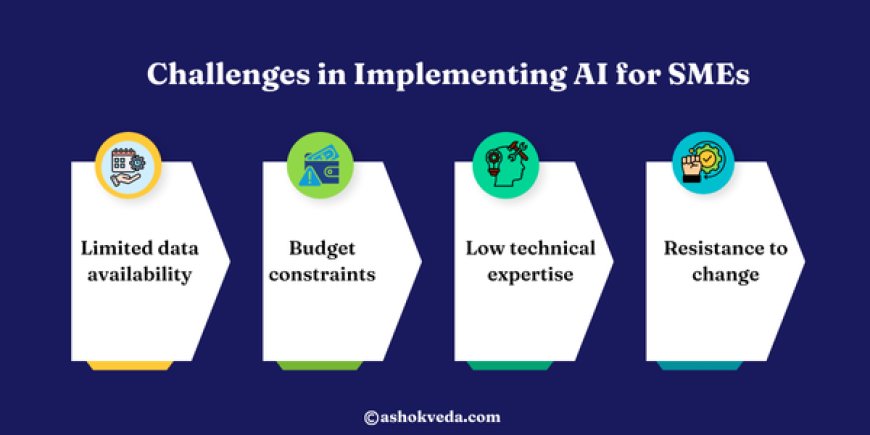
Challenges in Implementing AI for SMEs
While AI offers significant advantages, implementing it within SME environments comes with practical challenges that startups must carefully address. Unlike large enterprises, SMEs often lack the infrastructure, expertise, and resources needed for complex AI systems. Understanding these barriers is essential for building effective and sustainable AI solutions.
Key challenges include:
-
Limited data availability: Many SMEs do not collect structured or high-quality data, making it difficult to train accurate AI models.
-
Budget constraints: High development, integration, and maintenance costs can discourage SMEs from adopting AI technologies.
-
Low technical expertise: SME teams may lack the technical knowledge required to implement, manage, and interpret AI-driven systems.
-
Resistance to change: Employees and leadership may be hesitant to trust or adopt new technologies that alter existing workflows.
Successful AI for startup solutions focuses on simplicity, affordability, and delivering clear, measurable ROI to encourage adoption and long-term use.
Best Practices for Startups Building AI for SMEs
For AI solutions to succeed in SME environments, startups must prioritize usability, trust, and clear business value. Rather than building complex systems, the focus should be on solving specific problems that deliver quick and measurable results.
Best practices include:
-
Starting with simple, high-impact use cases that address immediate SME needs
-
Using explainable and transparent AI to build confidence and trust
-
Offering easy onboarding, training, and user-friendly interfaces
-
Ensuring strong data security, privacy, and regulatory compliance
-
Providing ongoing support and updates for continuous improvement
By following these practices, AI for Startups can achieve higher adoption rates, stronger trust, and long-term success within the SME ecosystem.
Future of SME Applications in AI for Startups
As artificial intelligence becomes more accessible, SMEs will increasingly adopt AI-driven solutions to improve efficiency and competitiveness. Advances in low-code platforms, cloud-based AI services, and prebuilt models are significantly lowering adoption barriers. This shift allows startups to develop AI solutions without heavy infrastructure or high costs. The future of AI for startups lies in creating affordable, scalable, and industry-specific tools that address real SME challenges rather than adding complexity. Startups that focus on practical use cases, ease of implementation, and measurable business outcomes will drive widespread adoption. By aligning innovation with genuine SME needs, these startups will shape the next phase of sustainable, AI-powered growth across industries.
AI is no longer a luxury reserved for large enterprises; it has become a practical growth partner for SMEs seeking to compete, adapt, and scale in dynamic markets. When startups design AI solutions around real SME constraints, such as limited budgets, data, and technical expertise, they create meaningful and lasting value. By prioritizing real-world use cases, ethical implementation, and measurable outcomes, AI for Startups can deliver tangible business impact. The long-term success of AI in the SME ecosystem depends on simplicity, trust, and strategic execution, enabling small businesses to adopt innovation confidently and achieve sustainable growth.