






















ROI of AI for Startups Investment: Measuring Profit, Growth, and Impact
Understand the real ROI of AI for Startups, from cost savings to revenue growth. A complete guide on benefits, metrics, strategies, and future value.

Artificial intelligence has become one of the most powerful tools for business growth, and startups are increasingly adopting AI to boost efficiency, enhance customer experience, and scale faster. But one critical question remains for every founder: What is the real ROI of AI for Startups?
AI is often seen as a high-tech, high-cost investment, but when implemented strategically, it delivers returns that far outweigh the initial expenses. From automation to customer insights, AI for Startups creates long-term value by improving accuracy, reducing human effort, and enabling smarter decision-making.
Understanding ROI in the AI for Startups Ecosystem
Return on Investment (ROI) is the measure of how much value your startup gains from applying AI technologies compared to what you spent. For new companies, calculating ROI goes beyond financial numbers; it includes time savings, improved productivity, customer satisfaction, and scalability.
AI for Startups empowers early-stage companies to operate more like established enterprises by leveraging data-driven intelligence. When used effectively, AI tools can replace repetitive tasks, speed up workflows, and generate insights that lead to better business decisions.
Key ROI metrics startups must track include:
-
Cost savings
-
Revenue growth
-
Customer retention
-
Productivity improvements
-
Reduction in manual errors
-
Faster decision-making
Measuring ROI helps startups justify investments to stakeholders, investors, and teams. It also ensures AI is aligned with long-term business goals.
Why ROI Matters in AI for Startups
AI is not just a trend; it is a transformational technology that shapes competitive advantage. But without measuring ROI, startups risk spending money on the wrong tools or optimizing the wrong processes.
ROI ensures that AI for Startups stays practical, results-driven, and directly connected to business growth.
Benefits of tracking ROI include:
-
Better budgeting and resource allocation
-
Clear understanding of AI’s impact
-
Ability to scale AI solutions with confidence
-
Stronger argument when pitching to investors
-
Early detection of inefficiency or underperforming AI models
ROI turns AI from a complex technology into a measurable business asset.
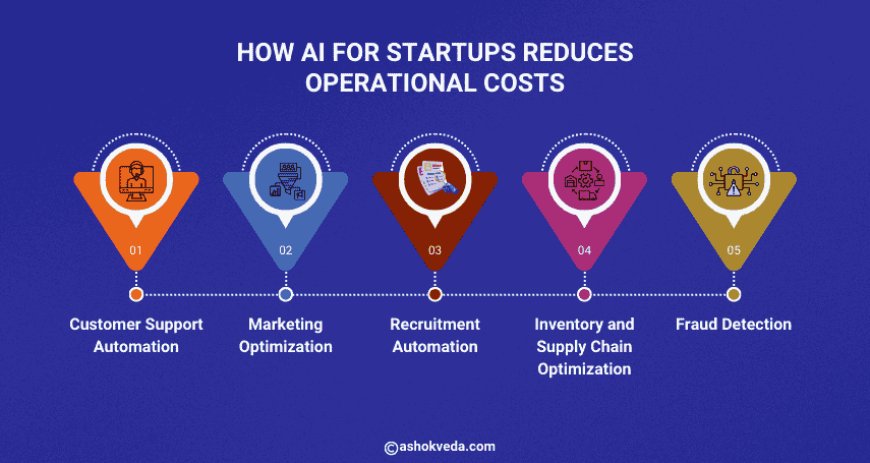
How AI for Startups Reduces Operational Costs
One of the clearest ways AI delivers measurable ROI is through cost reduction. Startups often operate with small teams and tight budgets, making efficiency crucial. AI automates processes, cuts down on human error, and handles repetitive tasks with accuracy.
Cost-saving areas where AI provides major returns:
-
Customer Support Automation
AI chatbots can handle up to 70% of FAQs, reducing support team load and staffing costs. -
Marketing Optimization
AI tools improve targeting, reducing cost per lead and increasing ad ROI. -
Recruitment Automation
AI screening tools speed up hiring, cutting both time and cost. -
Inventory and Supply Chain Optimization
Predictive tools help reduce waste and prevent overstock. -
Fraud Detection
AI models detect anomalies early, saving businesses from financial loss.
Operational savings often form a major percentage of the ROI of AI for Startups, especially during rapid expansion.
How AI for Startups Increases Revenue
Beyond cost savings, AI also drives direct revenue growth by improving personalization, customer insights, and sales strategies.
Revenue-enhancing AI applications include:
-
Personalized Recommendations
AI engines boost customer purchases through tailored suggestions. -
Sales Forecasting
Predictive analytics identify trends that increase sales accuracy. -
Dynamic Pricing Models
AI offers real-time pricing adjustments based on demand and market conditions. -
Lead Scoring Systems
AI identifies high-quality leads, improving conversion rates. -
Customer Churn Prediction
AI alerts companies before customers leave, enabling better retention.
A startup that uses AI to understand customer behavior often sees faster growth and higher lifetime value (LTV).
The Time-Saving Value of AI for Startups
Time savings contribute directly to ROI. AI reduces the hours spent on manual tasks and allows teams to focus on strategy and innovation.
Major time-saving areas include:
-
Data entry and processing
-
Report generation
-
Email categorization
-
Social media scheduling
-
Financial reconciling
-
Quality assurance testing
When employees spend less time on repetitive tasks, productivity rises—and productivity is a core ROI factor for AI for Startups.
How to Calculate ROI of AI for Startups
Calculating ROI may seem difficult, but it becomes simple when broken into clear steps.
Step 1: Identify total AI costs
This includes:
-
Software or tools
-
Development and deployment
-
Cloud processing
-
Training and onboarding
-
Maintenance and upgrades
Step 2: Measure direct financial gains
Examples:
-
Higher sales
-
Lower operational costs
-
Improved lead conversions
-
Reduced employee hours
Step 3: Measure indirect benefits
Examples:
-
Better customer experience
-
Reduced churn
-
Improved brand credibility
-
Prevention of costly errors
Step 4: Use the ROI formula
ROI = (Total Benefits – Total Costs) / Total Costs × 100
This percentage reveals whether your AI investment is profitable.
Long-Term Gains: The Compounding ROI of AI for Startups
AI provides long-term, compounding returns—meaning the value grows over time as your data, automation, and models improve.
Long-term ROI benefits include:
-
Enhanced accuracy through continuous learning
-
Better decision-making with larger datasets
-
Scalable systems that adapt automatically
-
Lower long-term resource consumption
-
Stronger customer loyalty and retention
-
Improved competitiveness in crowded markets
The compounding effect is a major reason investors fund AI-driven startups more aggressively.
High-ROI AI Use Cases for Startups
Not all AI tools deliver equal value. The best ROI occurs when AI directly aligns with business goals.
Top high-ROI AI applications include:
-
Predictive Analytics for Sales
-
AI Marketing Automation
-
Fraud Detection Models
-
Automated Content Generation
-
Recommendation Engines
-
Workflow Automation Tools
-
AI-Powered CRMs
Startups must choose use cases that solve immediate problems and contribute directly to scalability.
Common Mistakes Startups Make When Calculating AI ROI
While measuring ROI is essential, many startups miscalculate because they overlook hidden costs or underestimate long-term gains.
Common mistakes include:
-
Focusing only on short-term results
-
Ignoring time-saving benefits
-
Underestimating training and onboarding needs
-
Not monitoring AI performance regularly
-
Choosing AI tools without clear business goals
Avoiding these mistakes ensures accurate ROI tracking and better decision-making.
How Founders Can Maximize AI ROI
To get the highest ROI from AI for Startups, founders must combine strategic planning with data-driven execution.
Best practices for maximizing ROI:
-
Start with small, high-impact use cases
-
Use open-source AI tools to reduce costs
-
Measure KPIs consistently
-
Train teams to work with AI systems
-
Optimize and retrain models regularly
-
Scale successful AI solutions across departments
Consistent optimization is key to maintaining strong ROI in the long run.
Artificial intelligence has moved beyond being a luxury, it is now a growth engine for early-stage companies. By improving efficiency, enabling smarter decisions, and supporting fast innovation, AI for Startups delivers ROI across cost savings, revenue growth, and productivity. When startups use AI strategically, returns multiply over time, creating a competitive advantage that is hard to match. The startups that invest early and responsibly will lead in the future economy.