


















How to Integrate AI for Startups with Your Existing Systems
Learn how to integrate AI for Startups into existing systems with smooth workflows, strong data pipelines, and scalable, secure AI implementation.

For many founders, the biggest challenge isn’t building an AI model; it's integrating AI into the systems a startup already uses. Whether you run operations through CRM platforms, cloud applications, ERPs, or custom-built tools, the success of AI for Startups depends heavily on how smoothly it fits into existing workflows. Startups operate in fast-paced environments where every tool must communicate seamlessly to avoid disruptions, delays, or costly refactoring.
This is why integration becomes a mission-critical process. When executed correctly, integrating AI into existing systems helps startups automate tasks, improve decision-making, optimize workflows, and enhance the customer experience without rebuilding infrastructure from scratch. Explore the importance, challenges, strategies, and best practices for achieving smooth AI integration in early-stage companies using AI for Startups.
Why Integration Matters in AI for Startups
AI is only as effective as its ability to operate within the systems a startup already relies on. Integrating AI with current tools ensures continuity, accuracy, and efficiency while minimizing operational risks.
Key reasons integration is essential:
-
Ensures data flows seamlessly between systems and AI models
-
Improves model accuracy through real-time, high-quality data
-
Reduces manual processes and speeds up execution
-
Enhances user experience by embedding AI within familiar tools
-
Eliminates the need to overhaul existing architecture
-
Supports scalability and long-term growth
For AI for Startups, integration isn’t an optional technical step—it is a strategic advantage that allows small teams to leverage AI while remaining lean and efficient.
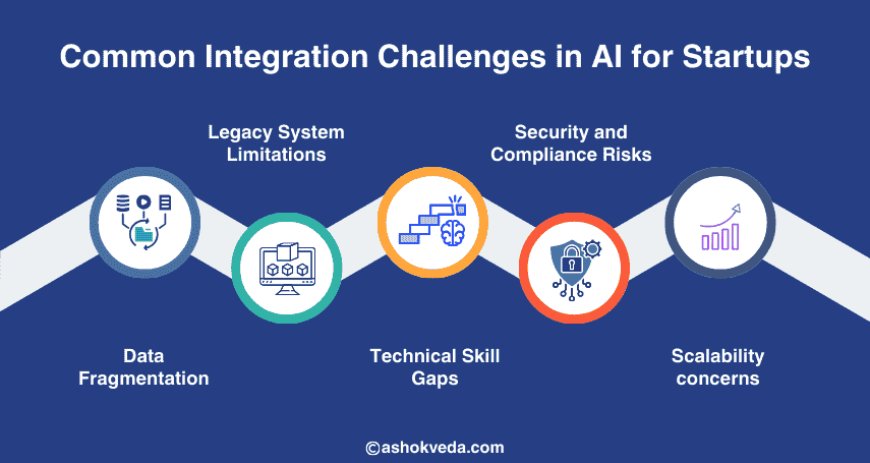
Common Integration Challenges in AI for Startups
While the benefits are clear, integrating AI with existing systems is not always straightforward. Startups face several technical and operational challenges that must be addressed early.
Many startups store data in multiple applications—sales tools, analytics dashboards, cloud storage, spreadsheets, and communication platforms.
This creates issues such as:
-
Inconsistent data formats
-
Missing or incomplete datasets
-
Lack of unified data pipelines
AI for Startups requires clean, structured, accessible data for reliable performance.
2. Legacy System Limitations
Some startups rely on older systems that may not support modern APIs or cloud-based AI platforms.
Challenges include:
-
Missing integration plugins
-
Outdated protocols
-
Limited documentation
Legacy tools often slow down the adoption of AI for Startups.
3. Technical Skill Gaps
Founders often lack specialized integration expertise. Without the right skills, challenges may arise around:
-
API management
-
Data mapping
-
Automation workflows
-
Security alignment
This increases the complexity of working with AI for Startups.
4. Security and Compliance Risks
Connecting multiple systems increases exposure to:
-
Data breaches
-
Unauthorized access
-
Compliance violations
Startups must safeguard AI-driven workflows from vulnerabilities.
If the integration architecture isn’t designed for growth, scaling becomes expensive and time-consuming, reducing the long-term impact of AI for Startups.
Best Practices for Integrating AI for Startups into Existing Systems
Successful integration requires a structured, strategic approach. Below are proven best practices designed specifically for early-stage companies.
1. Perform a Comprehensive System Audit
Before introducing AI, startups must evaluate the current system architecture.
Key steps:
-
Identify all connected tools and platforms
-
Map data sources, data types, and data flows
-
Evaluate existing API capabilities
-
Prioritize systems with the highest business impact
This audit helps determine the most efficient ways to integrate AI for Startups without disrupting daily operations.
2. Prioritize API-First Tools
API-first tools offer flexible, scalable connections that make AI integration easier.
Benefits of API-first platforms:
-
Faster data transfers
-
Lower integration costs
-
Better compatibility with cloud AI models
-
Easier automation workflow setup
Selecting tools with strong API support is a crucial step for startups using AI for Startups.
3. Use Middleware and Integration Platforms
Middleware tools act as bridges between AI models and existing systems.
Examples include workflow automation tools, integration-as-a-service platforms, and event-driven architectures.
Advantages:
-
Reduce custom coding
-
Simplify data routing
-
Speed up implementation
-
Improve reliability
This approach helps startups avoid building complex solutions from scratch when integrating AI for Startups.
4. Build Unified Data Pipelines
AI thrives on structured, consistent data. Creating unified pipelines ensures AI models receive accurate, high-quality input.
Core elements of strong pipelines:
-
Data cleaning
-
Data normalization
-
Real-time data flow
-
Centralized storage layer
-
Automated backups
This improves both model performance and long-term scalability in AI for Startups.
5. Start with Small, High-Impact Integrations
Rather than connecting AI to every system at once, begin with the most valuable use cases.
Examples:
-
Automating customer support responses
-
Predicting customer churn using CRM data
-
Enhancing lead scoring in sales platforms
-
Optimizing inventory systems
Small wins help teams build confidence with AI for Startups and gather feedback for bigger integrations.
6. Maintain Strong Security Protocols
Every integration point creates a potential vulnerability. Startups must enforce strict security controls.
Security measures to implement:
-
Encryption for data in transit and at rest
-
Strict access-control policies
-
API authentication keys
-
Regular integration audits
-
Compliance with GDPR, SOC 2, HIPAA (as needed)
Security is a foundational requirement for responsible AI for Startups.
7. Monitor Performance Continuously
Integration doesn’t end once systems connect. Ongoing monitoring ensures long-term stability and accuracy.
Monitor:
-
Data flow speed
-
Model performance metrics
-
System uptime
-
Error logs and failure patterns
-
User behavior and feedback
This allows startups to identify problems early and maintain high performance with AI for Startups.
Integration Strategies for Different Types of AI Solutions
Different AI tools require customized integration approaches:
1. Machine Learning Models
Integration often involves:
-
Deployment through APIs
-
Real-time inference pipelines
-
Batch processing for large datasets
-
Monitoring tools for performance
2. Natural Language Processing Tools
NLP features fit well into:
-
Chatbots
-
Email automation
-
Knowledge retrieval systems
-
Support ticket workflows
These integrations enhance user engagement through AI for Startups.
3. Computer Vision Systems
Common use cases include:
-
Quality control
-
Image classification
-
Security systems
-
Workflow automation
They require high computational resources and optimized pipelines.
Predictive models integrate best with:
-
CRM systems
-
Financial tools
-
Marketing automation
-
Inventory and logistics platforms
This enables more strategic decision-making using AI for Startups.
The Long-Term Impact of Strong Integration
Effective integration supports long-term scalability, user adoption, and business growth.
Benefits include:
-
Lower operating costs
-
Faster deployment cycles
-
Better customer experience
-
Improved model performance
-
Stronger competitive advantage
Integration transforms AI for Startups from a standalone feature into a core business asset.
Integration with existing systems is one of the most important steps in implementing AI for Startups. It ensures seamless workflows, faster decision-making, and scalable AI adoption. Startups that take a structured, strategic approach to integration achieve smoother operations, higher accuracy, and stronger long-term growth. By combining strong data pipelines, security protocols, and API-first tools, founders can unlock the full power of AI without disrupting their current ecosystem.