

















How to Implement an AI Strategy & Implementation Step by Step
Learn how to implement an AI strategy and implementation step by step. Understand planning, use cases, data readiness, governance, and scaling AI successfully.

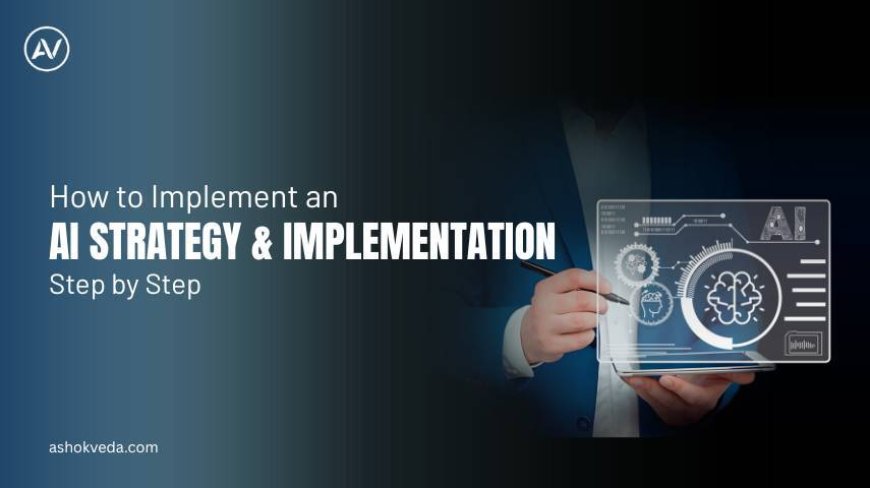
Artificial Intelligence is no longer optional for organizations that want to stay competitive in a digital-first economy. From improving efficiency to enabling smarter decisions, AI offers powerful capabilities across industries. However, simply adopting AI tools does not guarantee success. Many organizations fail to see results because they lack a clear roadmap. This is where AI Strategy & Implementation becomes essential.
Implementing AI successfully requires more than technology. It involves aligning AI initiatives with business goals, preparing data and systems, building the right skills, and managing change responsibly.
Understanding AI Strategy & Implementation
AI Strategy & Implementation is a structured approach to planning, deploying, managing, and scaling AI solutions within an organization. It ensures AI is embedded into core business operations rather than used as a one-time experiment. A strong AI strategy focuses on:
-
Addressing real business challenges
-
Using high-quality, well-governed data
-
Seamlessly integrating AI into workflows
-
Tracking performance and improving over time
Effective implementation turns strategy into measurable results, making execution as critical as planning.
Why AI Strategy & Implementation Is Important
Many organizations invest in AI technologies but fail to generate real business value due to poor strategic alignment. AI Strategy & Implementation bridges this gap by ensuring AI initiatives are goal-driven, scalable, and sustainable over time. It helps businesses move beyond experimentation and integrate AI into core operations.
Key benefits include:
-
Strong alignment between AI initiatives and business objectives
-
Lower risks and reduced wasted investments
-
Increased adoption and collaboration across teams
-
Improved governance, compliance, and ethical AI use
Without a structured implementation plan, AI projects often remain stuck at the pilot stage and fail to deliver long-term impact.
Step-by-Step Guide to Implement AI Strategy & Implementation
Step 1: Define Business Goals and AI Vision
The foundation of successful AI Strategy & Implementation begins with clarity. Organizations must clearly define why AI is needed and what outcomes they expect. AI should support business objectives such as improving efficiency, reducing costs, enhancing customer experience, or enabling better decision-making. At this stage, leadership alignment is critical. Clear goals ensure AI initiatives are purpose-driven and measurable rather than experimental or trend-driven.
Key actions include:
-
Identifying core business challenges
-
Setting measurable success metrics
-
Aligning AI initiatives with long-term strategy
Step 2: Identify and Prioritize AI Use Cases
Once objectives are clear, organizations must select the right AI use cases. Not every problem requires AI, and choosing the wrong use cases can delay results and waste resources. An effective AI strategy and implementation focus on use cases that are feasible, valuable, and scalable. Starting with high-impact but manageable projects increases early success and builds confidence across teams.
Key actions include:
-
Selecting use cases with clear business value
-
Evaluating feasibility based on data and skills
-
Prioritizing projects that can scale over time
Step 3: Prepare Data and Governance Foundations
Data readiness is one of the most important steps in AI Strategy & Implementation. AI systems depend on accurate, relevant, and well-governed data to perform effectively. Organizations must ensure that data is accessible, secure, and compliant with regulations. Strong governance reduces risk and improves trust in AI outcomes.
Key actions include:
-
Assessing data quality and availability
-
Establishing data governance policies
-
Ensuring privacy, security, and compliance
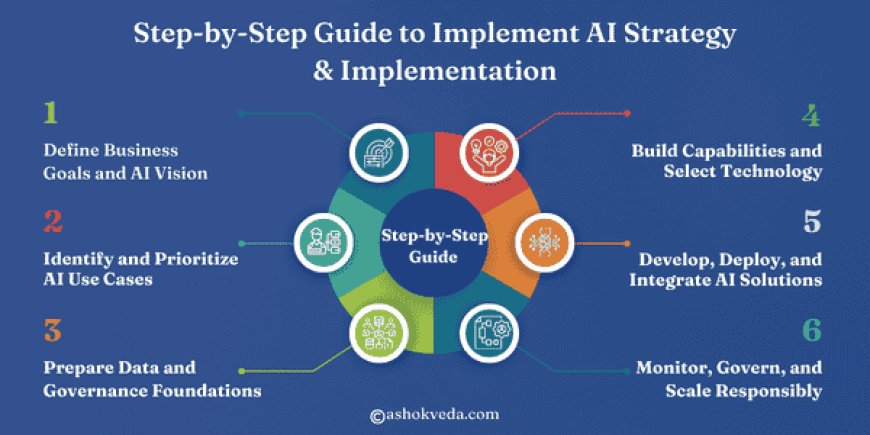
Step 4: Build Capabilities and Select Technology
AI Strategy & Implementation requires the right combination of people, skills, and technology. Organizations must decide whether to build internal capabilities, partner with experts, or adopt a hybrid approach. Technology choices should support scalability, integration, and long-term growth rather than short-term experimentation.
Key actions include:
-
Building cross-functional AI teams
-
Upskilling employees on AI tools
-
Selecting scalable and secure AI platforms
Step 5: Develop, Deploy, and Integrate AI Solutions
This step turns planning into execution. AI models are developed, tested, and integrated into existing business processes. Successful AI Strategy & Implementation focuses on usability and adoption, not just technical accuracy. AI must fit naturally into workflows so employees can use it confidently and effectively.
Key actions include:
-
Developing and testing AI models
-
Integrating AI into daily operations
-
Training users and supporting adoption
Step 6: Monitor, Govern, and Scale Responsibly
AI Strategy & Implementation does not end with deployment. Continuous monitoring ensures AI systems remain accurate, ethical, and aligned with business goals. Organizations should evaluate performance, address risks, and scale successful solutions responsibly across the organization.
Key actions include:
-
Tracking performance using KPIs
-
Monitoring bias, fairness, and compliance
-
Improving and scaling AI initiatives over time
Common Challenges During Implementation
During AI Strategy & Implementation, organizations often encounter several practical and operational challenges that can slow progress or reduce impact. One major issue is the lack of skilled professionals who can design, deploy, and manage AI systems effectively. Poor data quality and inconsistent data sources also limit model accuracy and reliability. Integrating AI solutions with existing systems can be complex and time-consuming. Additionally, resistance to change from teams may hinder adoption.
Organizations may face:
-
Skill shortages
-
Data quality issues
-
Integration complexity
-
Resistance to change
Identifying and addressing these challenges early significantly improves the success of AI Strategy & Implementation initiatives.
Best Practices for Long-Term Success
Sustaining AI Strategy & Implementation requires a disciplined and long-term approach rather than quick experimentation. Organizations should begin with focused use cases and scale AI solutions as value is proven. Aligning AI initiatives with core business priorities ensures relevance and impact. Continuous investment in skilled people and high-quality data strengthens outcomes, while ethical standards build trust and compliance. Regular reviews help organizations adapt to changing needs and improve performance over time.
To sustain AI Strategy & Implementation:
-
Start small and scale gradually
-
Align AI with business priorities
-
Invest in people and data
-
Maintain ethical standards
-
Review and improve continuously
These practices help organizations achieve consistent, long-term value from AI.
Common Mistakes to Avoid
Many organizations struggle with AI Strategy & Implementation because of avoidable mistakes made early in the process. Treating AI as a one-time project rather than an ongoing capability limits long-term value. Ignoring governance and ethical considerations can lead to compliance risks and loss of trust. Underestimating data requirements often results in poor model performance. Skipping user involvement reduces adoption and impact across teams.
Organizations often fail when they:
-
Treat AI as a one-time project
-
Ignore governance and ethics
-
Underestimate data needs
-
Skip user involvement
Avoiding these mistakes strengthens implementation outcomes and helps AI initiatives deliver sustainable business results.
Future of AI Strategy & Implementation
As AI technologies continue to advance, organizations will need more mature and flexible AI Strategy & Implementation frameworks to stay competitive. Future implementation efforts will prioritize scalable automation that improves efficiency across operations. Greater emphasis will be placed on human-AI collaboration, where AI supports decision-making rather than replacing people. Explainable and transparent AI will become essential for trust, compliance, and accountability. Additionally, industry-specific AI solutions will drive more targeted and measurable outcomes.
As AI evolves, implementation will focus more on:
-
Automation at scale
-
Human-AI collaboration
-
Explainable and transparent AI
-
Industry-specific AI solutions
Organizations with strong AI Strategy & Implementation foundations will adapt faster and gain long-term advantages in a quickly changing AI marketplace.
Implementing AI successfully requires more than technology. AI Strategy & Implementation provides the structure needed to align AI initiatives with business goals, manage risk, and deliver measurable value. By following a step-by-step approach, investing in data and people, and prioritizing ethics and governance, organizations can turn AI into a sustainable competitive advantage. A well-executed AI Strategy & Implementation transforms AI from experimentation into a powerful driver of innovation, efficiency, and long-term growth.