


















What is AI Strategy & Implementation?
Learn what AI Strategy & Implementation is, why it matters, and how businesses can plan, deploy, and scale AI solutions for real-world success.

Artificial Intelligence is no longer limited to large enterprises or research labs. Today, businesses of all sizes are adopting AI to improve efficiency, decision-making, and customer experience. However, simply adopting AI tools is not enough. To gain real value, organizations must follow a clear and well-planned approach known as AI Strategy & Implementation.
AI Strategy & Implementation refers to the structured process of planning, developing, deploying, and managing AI solutions to achieve specific business goals. It ensures that AI initiatives are aligned with organizational objectives, technical capabilities, and ethical standards. Without a strong strategy, AI projects often fail due to poor planning, lack of data readiness, or unclear outcomes.
Understanding AI Strategy & Implementation
AI Strategy & Implementation combines two critical components:
-
AI Strategy: The planning phase that defines how AI will support business goals
-
AI Implementation: The execution phase, where AI solutions are built, deployed, and monitored
Together, they form a roadmap that guides businesses from idea to impact.
An effective AI strategy answers key questions such as:
- What business problems should AI solve?
- What data is required?
- Which AI technologies are suitable?
- How will success be measured?
AI implementation then turns these answers into real-world systems that deliver measurable value.
Why AI Strategy & Implementation Is Important
Many organizations invest in AI tools but fail to see results. This usually happens due to the absence of a clear strategy.
AI Strategy & Implementation is important because it:
- Aligns AI projects with business objectives
- Reduces risks and unnecessary costs
- Improves decision-making through data-driven insights
- Ensures scalability and long-term success
- Builds trust through ethical and responsible AI use
Without a defined AI Strategy & Implementation, businesses may deploy isolated solutions that do not integrate well with existing workflows or deliver sustainable benefits.
Key Components of AI Strategy & Implementation
A successful AI Strategy & Implementation, framework includes several interconnected elements.
1. Business Goal Alignment
AI should solve real business problems, not just showcase advanced technology.
Key focus areas include:
- Improving operational efficiency
- Enhancing customer experience
- Automating repetitive tasks
- Enabling predictive insights
- Supporting strategic decision-making
Clear goals ensure AI investments deliver measurable outcomes.
2. Data Readiness and Management
Data is the foundation of AI. Without high-quality data, even the best models fail.
Important data considerations:
- Data availability and accessibility
- Data quality and accuracy
- Data privacy and security
- Data integration from multiple sources
AI Strategy & Implementation? requires strong data governance to ensure reliable and ethical data usage.
3. Technology and Tool Selection
Choosing the right technology is a critical part of AI Strategy & Implementation.
Organizations must evaluate:
- Machine learning frameworks
- Cloud-based AI platforms
- Open-source vs proprietary tools
- Integration capabilities with existing systems
Technology decisions should be based on scalability, cost, and business needs rather than trends.
4. Talent and Skills
AI success depends on skilled professionals who can design, implement, and manage AI systems.
Key roles include:
- Data scientists
- Machine learning engineers
- AI architects
- Domain experts
- Project managers
AI Strategy & Implementation often combines internal teams with external experts to fill skill gaps.
Steps Involved in AI Strategy & Implementation
A structured approach helps organizations avoid common pitfalls.
Step 1: Identify High-Impact Use Cases
Start with use cases that offer clear value and are feasible to implement.
Examples include:
- Customer support chatbots
- Demand forecasting
- Fraud detection
- Recommendation systems
- Process automation
Prioritizing use cases ensures quick wins and builds confidence in AI Strategy & Implementation.
Step 2: Assess Infrastructure and Capabilities
Before implementation, organizations must evaluate their readiness.
Assessment areas:
- Existing IT infrastructure
- Data storage and processing capacity
- Integration with current systems
- Security and compliance readiness
This step ensures smooth AI deployment without major disruptions.
Step 3: Develop and Test AI Models
This phase involves building AI models using historical data.
Key activities include:
- Data preparation and labeling
- Model selection and training
- Performance evaluation
- Bias and accuracy testing
Testing is essential to ensure AI systems are reliable, fair, and effective.
Step 4: Deploy and Integrate AI Solutions
Deployment is where AI Strategy & Implementation becomes operational.
Deployment considerations:
- API integration with business systems
- User experience and adoption
- Monitoring system performance
- Handling real-time data
Proper integration ensures AI solutions fit seamlessly into daily operations.
Step 5: Monitor, Improve, and Scale
AI systems require continuous monitoring and improvement.
Post-deployment activities include:
- Tracking performance metrics
- Updating models with new data
- Addressing errors and biases
- Scaling solutions across departments
Continuous improvement keeps AI relevant and valuable over time.
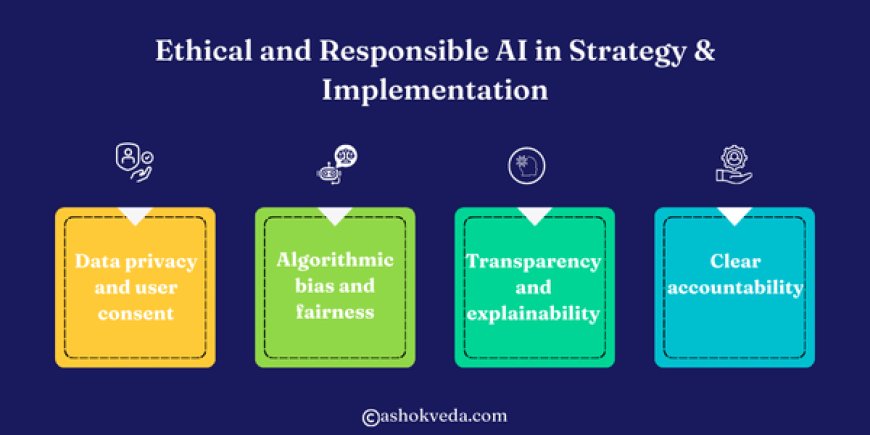
Ethical and Responsible AI in Strategy & Implementation
Ethics is a core pillar of effective AI Strategy & Implementation. Organizations must ensure that AI systems are designed and deployed responsibly to protect users and maintain long-term credibility. Ignoring ethical considerations can lead to legal issues, reputational damage, and loss of user trust. A strong ethical foundation helps organizations balance innovation with accountability.
Organizations must address:
- Data privacy and user consent to safeguard sensitive information
- Algorithmic bias and fairness to ensure equitable outcomes
- Transparency and explainability so AI decisions are understandable
- Clear accountability for AI-driven actions and results
Responsible AI practices strengthen trust among users, regulators, and stakeholders while minimizing long-term operational and compliance risks.
Common Challenges in AI Strategy & Implementation
Despite its strong potential, AI Strategy & Implementation comes with several practical challenges that organizations must address early. Without the right foundation, AI initiatives may fail to deliver measurable value. Many challenges arise from gaps in planning, resources, and organizational readiness rather than technology itself.
Key challenges include:
- Unclear business objectives that weaken AI direction and outcomes
- Poor data quality or limited availability is affecting model accuracy
- Skill shortages in AI, data science, and engineering roles
- Integration complexity with existing systems and workflows
- Resistance to change from teams adapting to AI-driven processes
These challenges can be effectively managed through structured planning, strong leadership support, continuous training, and a phased, well-governed implementation approach.
Best Practices for Successful AI Strategy & Implementation
To achieve long-term success, organizations must approach AI Strategy & Implementation with clear goals and disciplined execution. Applying proven best practices helps reduce risk, improve adoption, and ensure AI initiatives create real business impact rather than isolated experiments.
Recommended best practices:
- Start small and scale gradually to test feasibility and minimize risk
- Focus on measurable outcomes aligned with business objectives
- Promote collaboration between business leaders and technical teams
- Invest in training and upskilling to build internal AI capabilities
- Maintain transparency and ethical standards throughout deployment
By following these best practices, organizations can ensure AI Strategy & Implementation delivers sustainable, scalable value while building trust and operational efficiency.
Measuring Success of AI Strategy & Implementation
Measuring success is essential to ensure AI Strategy & Implementation delivers real business value. Clear, well-defined metrics help organizations track performance, justify investments, and identify areas for improvement. Without regular evaluation, AI initiatives may fail to align with evolving business goals.
Common evaluation metrics include:
- Cost savings and efficiency gains from automation and optimization
- Revenue growth driven by AI-powered insights and personalization
- Accuracy and performance improvements in AI models and outputs
- User adoption rates across teams and customers
- Customer satisfaction and experience enhancements
Continuous measurement enables organizations to refine their AI Strategy & Implementation over time, ensuring scalability, relevance, and long-term success.
Future of AI Strategy & Implementation
As AI technologies continue to advance, AI Strategy & Implementation will become a central part of long-term business planning. Organizations will move beyond experimentation toward deeply embedded, intelligent systems that support faster and smarter decision-making. A structured approach will be essential to manage complexity, risk, and scale.
Future trends include:
- Increased automation of decision-making across business functions
- Stronger focus on explainable AI to improve transparency and trust
- Wider adoption of AI governance frameworks for compliance and control
- Deeper collaboration between humans and AI systems to enhance productivity
Organizations that invest early in a well-defined AI Strategy & Implementation will be better positioned to gain a lasting competitive advantage in the evolving digital economy.
AI Strategy & Implementation is not a one-time project but a continuous journey. It connects business vision with advanced technology to create a meaningful impact. By aligning AI initiatives with clear goals, strong data practices, ethical standards, and continuous improvement, organizations can unlock the full potential of artificial intelligence. A well-executed AI Strategy & Implementation ensures that AI is not just adopted but truly embedded into business success.