











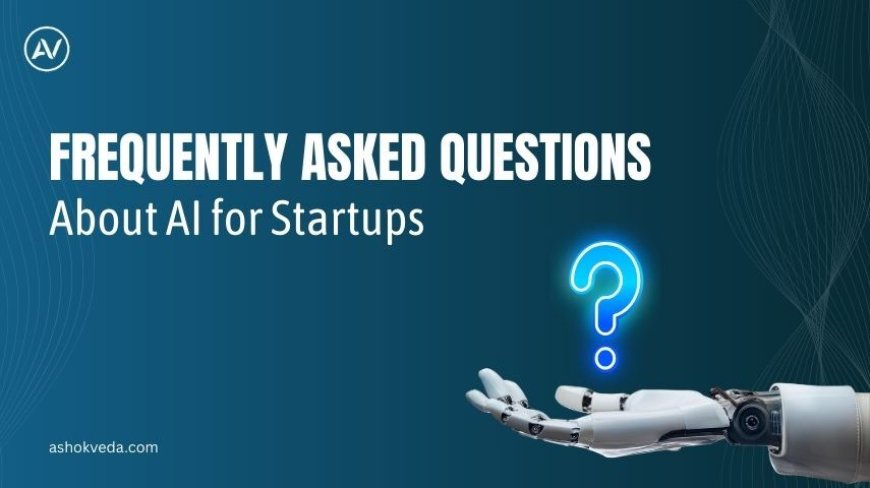
Frequently Asked Questions About AI for Startups
Learn why AI for Startups matters more than ever in 2026, including trends in automation, efficiency, regulation, and scalable innovation.

Artificial intelligence is transforming how modern businesses operate, and startups are no exception. From automating daily tasks to improving decision-making, AI for Startups has become a powerful tool for growth and innovation. However, many founders still have questions about how AI works, what it costs, and whether it is practical for early-stage businesses. Misunderstandings often prevent startups from taking advantage of AI at the right time.
Why This Matters in 2026: A Quick Snapshot of the Industry
In 2026, artificial intelligence has moved from experimentation to expectation. Startups are no longer asking whether to adopt AI, but how fast they can implement it effectively. With rising competition, tighter funding environments, and increasing customer expectations, AI for Startups has become a strategic necessity rather than a technical upgrade.
Key industry shifts driving this urgency include:
- Wider access to affordable cloud and open-source AI tools
- Growing pressure to operate lean with higher efficiency
- Increased use of data-driven decision-making across sectors
- Stronger focus on automation to offset talent shortages
- Rising regulatory and ethical scrutiny around AI usage
Startups that understand and adopt AI early in 2026 gain a clear advantage in scalability, credibility, and long-term resilience, while those that delay risk falling behind in an AI-first business environment.
Top FAQs About AI for Startups
1. What is AI for Startups?
"AI for Startups" refers to the use of artificial intelligence technologies by early-stage businesses to solve specific business problems. This includes automation, data analysis, prediction, personalization, and decision support. Unlike enterprise AI, startup AI focuses on efficiency, scalability, and affordability while addressing real operational challenges.
2. Why should startups consider using AI?
Startups should consider AI because it helps them do more with fewer resources. AI automates repetitive tasks, improves accuracy, and enables faster decision-making. In competitive markets, AI for Startups provides a technological edge that supports growth without proportionally increasing costs.
3. Is AI only suitable for tech startups?
No. AI is industry-agnostic. Non-tech startups in retail, healthcare, finance, logistics, education, and marketing use AI for Startups to improve customer service, optimize operations, and analyze trends. AI solves business problems, not just technical ones.
4. Do startups need large budgets to implement AI?
Startups do not need massive budgets to start with AI. Many cloud-based platforms and open-source tools offer affordable entry points. AI for Startups can begin with pilot projects that require minimal investment and scale as value is proven.
5. What are the most common use cases of AI for startups?
Common applications include:
- Chatbots for customer support
- Predictive analytics for sales and demand
- Marketing personalization
- Fraud detection and risk analysis
- Workflow and process automation
These use cases deliver quick ROI and are ideal starting points for AI for Startups.
6. Do startups need in-house AI experts?
In-house experts are helpful but not mandatory. Many startups rely on AI vendors, consultants, or cloud services when starting. Over time, startups may build internal capabilities as AI for Startups becomes a core business function.
7. What kind of data is required for AI systems?
AI systems need relevant, clean, and structured data. The quality of data is more important than the volume. For AI for Startups, even small datasets can be effective if they are accurate and aligned with business objectives.
8. How long does it take to implement AI in a startup?
Implementation timelines vary. Simple AI tools can be deployed within weeks, while custom AI solutions may take several months. The scope, data readiness, and integration complexity influence timelines in AI for Startups.
9. Is integrating AI with existing systems difficult?
Most modern AI solutions are designed for easy integration using APIs. Challenges may arise with legacy systems, but experienced vendors simplify this process. Seamless integration ensures AI for Startups enhances existing workflows rather than disrupting them.
10. How secure is AI for startups?
AI security depends on implementation practices. Secure AI for Startups solutions use encrypted data storage, role-based access, and compliance with data protection laws. Choosing trustworthy vendors is critical to maintaining security.
11. Who owns the data used in AI systems?
Data ownership depends on contracts with vendors. Startups should ensure they retain ownership of both raw data and trained models. Clear ownership builds trust and protects long-term value in AI for Startups.
12. Can AI help startups reduce operational costs?
Yes. AI reduces costs by automating manual tasks, minimizing errors, and optimizing workflows. Over time, AI for Startups lowers labor expenses and increases efficiency across departments.
13. Is AI scalable as a startup grows?
AI systems are inherently scalable when designed properly. Cloud-based infrastructure allows startups to scale AI solutions alongside business growth, making AI for Startups suitable for long-term expansion.
14. What is the difference between AI tools and custom AI?
AI tools are pre-built solutions with fixed features, while custom AI is tailored to specific business needs. Custom AI for Startups offers better flexibility, control, and competitive advantage over time.
15. Are AI results always accurate?
AI accuracy depends on data quality, training methods, and continuous monitoring. Startups must regularly update models to maintain reliability. Continuous improvement is essential for effective AI for Startups.
16. Can AI replace human employees in startups?
AI does not replace humans; it supports them. AI for Startups handles repetitive and data-heavy tasks, allowing employees to focus on creativity, strategy, and relationship-building.
17. How does AI improve customer experience?
AI improves customer experience by providing faster responses, personalized recommendations, and predictive support. These capabilities help startups build stronger relationships through AI for Startups solutions.
18. Is AI ethical for startups to use?
Yes, when implemented responsibly. Ethical AI for Startups includes transparency, fairness, bias mitigation, and secure handling of user data. Responsible AI builds long-term trust.
19. What risks should startups consider before adopting AI?
Key risks include:
- Poor data quality
- Vendor lock-in
- Unrealistic expectations
- Lack of ethical oversight
- Addressing these risks ensures sustainable AI for Startups adoption.
20. How can startups measure the success of AI?
Success is measured using KPIs such as cost savings, productivity gains, customer satisfaction, and revenue growth. Clear metrics help startups evaluate AI for Startups effectiveness.
21. Which industries benefit most from AI for startups?
Industries with data-driven operations benefit the most, including fintech, e-commerce, healthcare, SaaS, logistics, and marketing. However, AI for Startups can benefit nearly any sector.
22. Can AI help startups attract investors?
Yes. AI-driven insights and automation demonstrate scalability and innovation. Startups using AI for Startups effectively often appear more attractive to investors.
23. Should startups start small or fully invest in AI?
Starting small is recommended. Pilot projects allow startups to test ROI before scaling. This phased approach reduces risk in AI for Startups adoption.
24. What role do AI vendors play for startups?
AI vendors provide expertise, tools, and infrastructure. They help startups deploy AI faster and reduce technical barriers in AI for startup initiatives.
25. What is the future of AI for startups?
The future of AI for Startups lies in affordable, customizable, and responsible AI. AI will become a core business asset rather than an optional tool.
AI is no longer optional for startups aiming to stay competitive in a data-driven world. As these FAQs show, AI for Startups is practical, scalable, and increasingly accessible across industries. When adopted thoughtfully, AI helps startups automate operations, improve decision-making, enhance customer experience, and build long-term value. By focusing on responsible implementation, data quality, and clear business goals, startups can overcome common challenges and unlock the full potential of AI. Rather than replacing human effort, AI empowers founders and teams to work smarter and grow faster in an increasingly intelligent business environment.