













Real-World Success Stories in AI for Startups
Learn how real startups achieved growth and efficiency through AI for Startups, with practical success stories, use cases, and measurable business results.

Artificial intelligence is no longer limited to large enterprises or experimental labs. Today, startups are actively using AI to solve real business challenges, streamline operations, and unlock new growth opportunities. From automating customer support to improving decision-making and personalization, AI for Startups is delivering measurable impact across industries. Real-world success stories offer valuable insights into what works, what doesn’t, and how thoughtful AI adoption drives results. By examining how startups have applied AI in practical settings, founders can learn from proven strategies, avoid common pitfalls, and build scalable, trustworthy solutions that create lasting business value.
Why Real-World Success Stories Matter in AI for Startups
Many startup founders hesitate to adopt AI because of concerns around cost, complexity, and uncertain returns. Real-world success stories help overcome these doubts by showing how AI performs in practical business environments, not just in theory. They provide concrete examples of startups using AI to solve specific problems and achieve measurable outcomes.
These stories help startups:
- Understand practical and achievable AI use cases
- See real results, performance improvements, and ROI
- Learn from implementation challenges and solutions
- Build confidence in AI-driven decision-making
By studying proven examples, founders can approach AI for Startups with clarity, confidence, and realistic expectations.
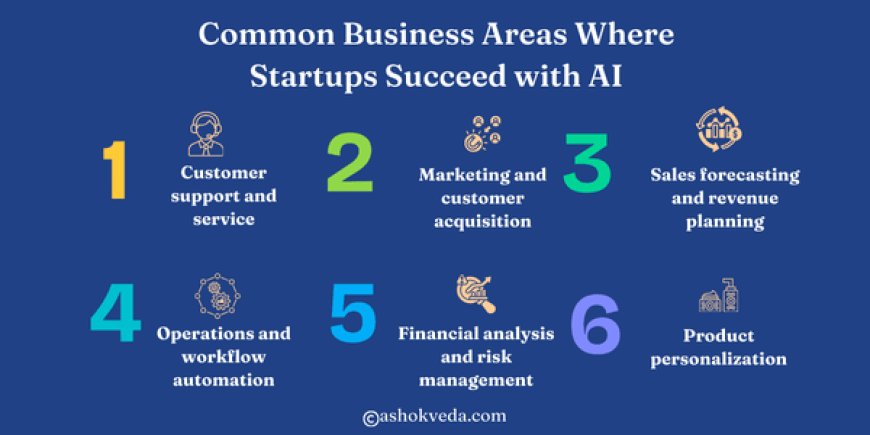
Common Business Areas Where Startups Succeed with AI
Successful AI adoption in startups often begins with business areas where efficiency gains and insights create immediate impact. Across industries, AI success stories repeatedly show value in functions that rely on data, speed, and scalability.
The most common areas include:
-
Customer support and service, using chatbots and automation to improve response times
-
Marketing and customer acquisition, through personalization and targeting
-
Sales forecasting and revenue planning, driven by predictive analytics
-
Operations and workflow automation, reducing manual effort
-
Financial analysis and risk management, improving accuracy and control
-
Product personalization, enhancing user experience
These examples demonstrate the flexibility and real-world impact of AI for Startups across core business functions.
Success Story 1: Scaling Customer Support with AI Automation
Customer support is often one of the first areas where startups experience operational strain. A growing SaaS startup faced rising support requests without the budget to expand its team.
AI Implementation Approach
- Deployed an AI-powered chatbot
- Trained models using historical support data
- Integrated the chatbot with existing support tools
Business Results
- Reduced response time by more than 60%
- Automated answers for repetitive queries
- Improved customer satisfaction ratings
- Allowed human agents to focus on complex issues
This example shows how AI for Startups improves service quality while keeping costs under control.
Success Story 2: Improving Marketing Performance with AI Insights
Marketing effectiveness is critical for startups competing with limited budgets. One digital-first startup used AI-driven analytics to optimize its marketing strategy.
AI Use Case
- Customer segmentation using behavioral data
- Predictive analytics for campaign performance
- Personalized content recommendations
Outcomes Achieved
- Higher lead conversion rates
- Reduced customer acquisition costs
- Improved engagement across channels
- Better data-driven decision-making
Through targeted insights, AI for Startups enabled smarter, more efficient marketing efforts.
Success Story 3: AI-Driven Sales Forecasting for Better Planning
Accurate sales forecasting is a challenge for many early-stage companies. A B2B startup struggled with inconsistent revenue predictions and resource planning.
- Implemented machine learning models
- Analyzed historical sales and customer data
- Identified patterns and buying behavior
Measurable Impact
- More reliable revenue forecasts
- Improved inventory and staffing decisions
- Better alignment between sales and operations
- Increased confidence among investors
This story highlights how AI for Startups supports strategic planning and long-term stability.
Success Story 4: Streamlining Operations Through AI Automation
Operational inefficiencies can slow down growth and increase costs. A logistics-focused startup turned to AI to optimize its internal workflows.
AI Applications Used
- Automated scheduling and routing
- Predictive analysis for demand planning
- Workflow optimization
Results Delivered
- Reduced manual workload
- Faster decision-making
- Lower operational expenses
- Improved delivery timelines
Automation-focused AI solutions for startups free teams to focus on innovation and strategy.
Success Story 5: Strengthening Financial Control with AI
Managing finances effectively is critical for startup survival. A fintech startup adopted AI to gain better financial visibility and risk management.
AI Capabilities Applied
- Transaction analysis
- Anomaly and fraud detection
- Cash flow forecasting
Business Benefits
- Early detection of financial risks
- Reduced fraud incidents
- Improved regulatory compliance
- More informed financial planning
This success story reinforces trust and authority in AI for Startups, especially in data-sensitive industries.
What These Success Stories Have in Common
Although AI success stories span different industries and business models, they consistently share a set of common traits. These patterns reveal why some startups achieve meaningful results with AI while others struggle.
Key Patterns Observed
- Clear identification of specific business problems before adopting AI
- Focus on high-impact use cases rather than experimenting broadly
- Gradual implementation instead of immediate, full-scale deployment
- Continuous optimization using data, feedback, and performance metrics
- Strong alignment between AI initiatives and overall business goals
These shared characteristics highlight that AI success is driven by strategy and clarity, not just technology. When applied thoughtfully, AI for Startups delivers sustainable value and long-term growth.
Challenges Startups Faced During AI Adoption
AI success stories often include obstacles that startups had to overcome.
Common Challenges
- Limited or unstructured data
- Lack of internal AI expertise
- Integration with existing systems
- Budget constraints
How Startups Overcame These Challenges
- Started with small pilot projects
- Used cloud-based or hybrid AI solutions
- Partnered with experienced AI vendors
- Prioritized use cases with quick ROI
Addressing these challenges strengthens experience and trust in AI for startup adoption.
Lessons Startups Can Learn from AI Success Stories
Founders planning to adopt AI can draw several important lessons from real-world examples.
Practical Takeaways
- AI should solve specific business problems
- Customization often delivers higher ROI
- Data quality is more important than data volume
- AI adoption requires continuous improvement
- Ethical and secure AI builds long-term trust
Applying these lessons increases the likelihood of success in AI for startup initiatives.
The Growing Future of AI Success for Startups
The future of AI adoption for startups is becoming increasingly promising as tools grow more accessible and easier to implement. Advances in low-code platforms, cloud-based AI services, and open-source frameworks are reducing technical and financial barriers. This allows startups of all sizes to experiment, deploy, and scale AI solutions faster than ever before. Over time, AI for Startups will move beyond pilot projects and become an essential part of everyday business operations. Startups that learn from existing success stories and invest early in practical AI applications will gain lasting competitive advantages, improve operational resilience, and position themselves strongly for long-term growth in an AI-driven market.
Real-world success stories show that AI is far more than a trend; it is a practical tool that drives measurable results for startups. When applied with clear goals and responsible execution, AI for Startups enhances efficiency, decision-making, and customer experiences across functions. Learning from proven examples helps founders reduce risk, build trust, and make smarter investments. Ultimately, AI success is not about complexity or hype, but about using intelligent solutions in areas that create real and lasting business impact.