






















Top KPIs That Define AI for Startups Success
Understand key KPIs for AI for Startups success. Measure model performance, ROI, user impact, and operational efficiency with a clear, structured framework.

Artificial intelligence is now a core driver of innovation, scalability, and competitive advantage. But simply building or deploying an AI system does not guarantee success, especially for startups that rely heavily on fast growth, lean operations, and validated decision-making. This is where KPIs become essential. Key Performance Indicators help founders measure whether their AI investments are generating real value. For AI for Startups, proper KPI tracking ensures that teams remain focused on outcomes instead of getting lost in technical complexity. KPIs also help guide funding decisions, improve operational efficiency, and reduce the risk of scaling prematurely. In a startup environment where every resource counts, knowing which metrics matter can determine whether an AI initiative becomes a growth engine or an expensive distraction.
Why KPIs Matter in AI for Startups
KPIs serve as a measurable way to evaluate performance and progress. For AI for Startups, they help answer important questions such as:
-
Is the AI model performing as expected?
-
Is the AI-driven product improving user experience?
-
Is the startup saving money, generating revenue, or reducing manual workload?
-
Are founders making data-driven decisions based on measurable outcomes?
Startups often deal with uncertainty, limited budgets, and rapidly changing priorities. KPIs reduce this chaos by creating a clear feedback loop. They help founders validate assumptions, improve their AI systems, and assess whether the investment is worth expanding. With strong KPI tracking, startups can justify funding requests, attract strategic partners, and build investor confidence.
Types of KPIs to Measure AI for Startups Success
KPIs fall into several major categories. Together, they provide a full picture of AI performance and business value.
1. Technical Performance KPIs
These metrics evaluate how well the AI model itself is performing. For AI for Startups, poor technical performance often leads to higher support costs, reduced trust, and product failure.
Key Technical KPIs
-
Accuracy: Measures how often the model gives correct predictions. Useful for classification and decision-making systems.
-
Precision and Recall: Precision measures how accurate positive predictions are, while recall measures how many real positives the model captured. Both are critical for applications like fraud detection or medical triage.
-
Model Training Time: Helps measure how quickly a startup can experiment, test, and deploy new models.
-
Inference Time: Measures response speed when the model makes predictions. Users expect fast results in real-world applications.
-
Model Drift Rate: Shows how quickly model performance changes due to new data or evolving patterns.
2. Product and User Experience KPIs
These KPIs show whether the AI system is improving the product and enhancing customer satisfaction.
Key Product Experience KPIs
-
User Adoption Rate: Tracks how many users actively engage with AI-driven features.
-
Customer Satisfaction Score (CSAT): Measures how users feel about the AI features after interacting with them.
-
Net Promoter Score (NPS): Shows whether AI-driven improvements encourage users to recommend the product.
-
Feature Usage Frequency: Indicates whether AI features are actually valuable or just perceived as “nice-to-have.”
-
Churn Reduction: Shows how AI-driven personalization or recommendations help retain customers.
3. Operational Efficiency KPIs
AI for Startups often focuses on automation and workflow improvements. These KPIs measure time savings and process enhancements.
Key Operational KPIs
-
Time Saved Through Automation: Measures hours saved by replacing manual tasks with AI.
-
Manual Error Reduction: Shows how AI improves accuracy in tasks like data entry, reporting, or analysis.
-
Cost Reduction from AI Integration: Indicates how much money the startup saves using AI instead of human labor or third-party tools.
-
Process Completion Speed: Tracks how quickly operations run after AI implementation.
-
Employee Productivity Improvement: Measures the impact of AI tools on internal teams.
4. Financial ROI KPIs
Startups must closely monitor financial returns to justify investments in AI systems.
Key Financial KPIs
-
Return on Investment (ROI): Measures whether AI investments contribute positively to financial performance.
-
Revenue Driven by AI Features: Tracks direct income from AI-powered products or upgrades.
-
Customer Lifetime Value (CLV) Growth: Shows how AI-driven personalization or retention strategies increase long-term revenue.
-
Customer Acquisition Cost (CAC) Reduction: Indicates whether AI helps reduce marketing, targeting, or sales costs.
-
AI Operating Cost Efficiency: Measures infrastructure and model maintenance costs relative to outputs.
5. Data Quality and Governance KPIs
AI for Startups relies heavily on clean, organized, and compliant data. These KPIs ensure that data inputs remain reliable.
Key Data Governance KPIs
-
Data Accuracy Rate: Measures how clean and error-free the datasets are.
-
Data Availability: Tracks how easily teams can access the data needed for training and improvement.
-
Rate of Missing or Incomplete Data: Shows how often AI systems encounter gaps in the input.
-
Compliance and Privacy Audit Score: Evaluates whether the startup meets regulations like GDPR or HIPAA.
-
Data Freshness: Tracks how up-to-date the data is for real-time insights.
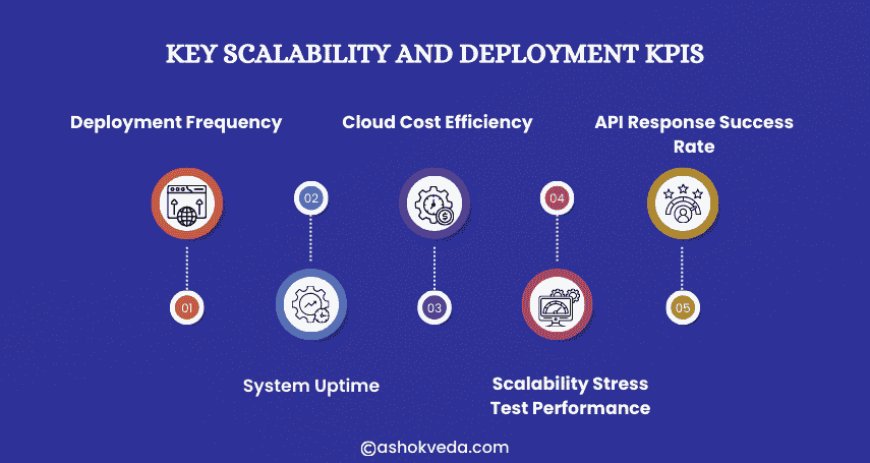
6. Scalability and Deployment KPIs
As AI for Startups grows, scalability becomes a critical factor.
Key Scalability KPIs
-
Deployment Frequency: Measures how quickly the startup can release model updates or improve algorithms.
-
System Uptime: Ensures that AI systems are available when users need them.
-
Cloud Cost Efficiency: Tracks spending on compute, storage, and AI infrastructure.
-
Scalability Stress Test Performance: Shows how well AI systems handle increased traffic or data volume.
-
API Response Success Rate: Indicates stability and reliability when AI features rely on API integrations.
How to Choose the Right KPIs for AI for Startups
Selecting KPIs should reflect the startup's goals, product stage, and customer needs.
Steps to Select Relevant KPIs
-
Identify the core purpose of the AI system.
-
Define the business problem the AI solution addresses.
-
Align KPIs with desired user outcomes.
-
Choose measurable and realistic metrics.
-
Avoid tracking too many KPIs at once.
-
Communicate KPI goals clearly across teams.
Founders must balance technical KPIs with business-focused ones to understand the full impact.
Common Mistakes Startups Make with KPIs
Monitoring KPIs helps, but tracking the wrong ones can lead to misalignment.
Common Pitfalls
-
Focusing only on accuracy without considering real-world outcomes.
-
Tracking too many metrics and diluting priorities.
-
Ignoring user experience or product impact.
-
Not updating KPIs as the startup grows.
-
Measuring outputs instead of outcomes.
Successful AI for Startups requires disciplined KPI selection and clear reporting routines.
Best Practices for Measuring AI for Startups Success
To maximize results, startups should follow proven approaches.
Best Practices
-
Combine technical, financial, and product KPIs for a balanced scorecard.
-
Review KPIs weekly or monthly to catch early issues.
-
Use dashboards to visualize model performance and trends.
-
Set clear benchmarks before deploying AI features.
-
Map KPIs to investor updates or board reports.
-
Conduct regular model audits to prevent drift.
Consistent measurement helps build reliable, trustworthy AI systems.
AI has become a powerful catalyst for innovation, but for startups, success is not just about building smart models. It is about proving value, boosting efficiency, improving user experiences, and generating measurable returns. KPIs offer a structured way to evaluate performance across technical, operational, financial, and product dimensions. By tracking the right KPIs, founders can ensure that AI for Startups becomes a long-term asset rather than an expensive experiment. Strong KPI measurement builds accountability, supports strategic decision-making, and accelerates growth. For any emerging company investing in AI, mastering KPI-based evaluation is one of the most important steps toward sustainable success.