
















Key Challenges in AI Strategy & Implementation
Explore the key challenges in AI Strategy & Implementation, including data issues, skill gaps, ethics, integration risks, and scalability barriers.

Artificial Intelligence is transforming the way organizations operate, compete, and innovate across industries. From intelligent automation and advanced analytics to personalization and predictive insights, AI offers immense potential to create business value. However, realizing these benefits is not as simple as adopting new technology. Many organizations struggle because AI tools alone do not guarantee success. The real challenge lies in developing and executing a well-defined AI Strategy & Implementation that aligns technology with clear business objectives.
Without a structured approach, AI initiatives often result in delays, budget overruns, low user adoption, and minimal impact. Understanding the challenges in AI Strategy & Implementation is crucial for organizations aiming to move beyond experimentation and build scalable, sustainable AI-driven capabilities.
Understanding AI Strategy & Implementation
AI Strategy & Implementation is the end-to-end approach organizations use to plan, deploy, manage, and scale AI solutions effectively. It ensures that AI initiatives are driven by business priorities, supported by high-quality data, governed responsibly, and continuously improved over time. A structured strategy helps organizations turn AI from isolated experiments into reliable, value-generating systems.
A strong AI strategy includes:
- Clear business objectives for focused AI adoption
- Selection of high-impact use cases aligned with goals
- Data readiness and governance frameworks to ensure accuracy
- Integration with existing systems for seamless operations
- Ongoing monitoring and improvement to maintain performance
Despite its importance, many organizations face significant challenges while executing AI Strategy & Implementation at scale.
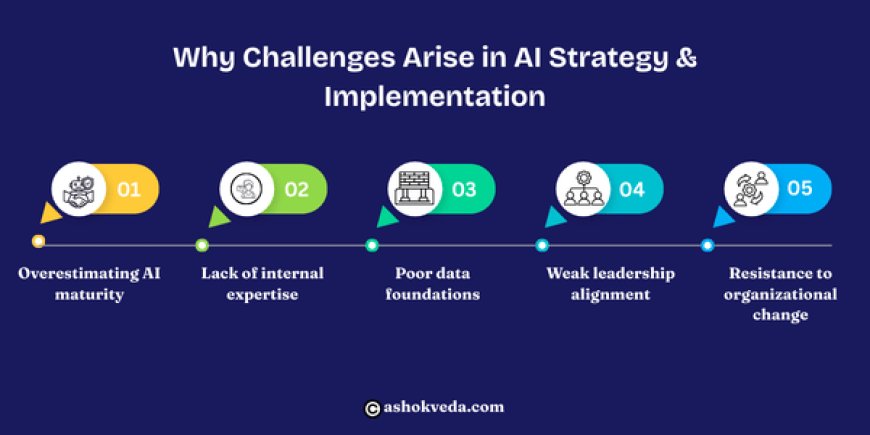
Why Challenges Arise in AI Strategy & Implementation
AI initiatives often fail not because the technology is ineffective, but because organizations underestimate the complexity involved. AI Strategy & Implementation requires close coordination between leadership, technology, data, people, and processes. When these elements are not aligned, even well-funded AI projects can lose direction or stall before delivering value.
Common reasons challenges arise include:
- Overestimating AI maturity within the organization
- Lack of internal expertise to manage AI systems
- Poor data foundations that limit model accuracy
- Weak leadership alignment on AI goals and priorities
- Resistance to organizational change among teams
Addressing these challenges early through planning, communication, and governance is essential for successful and sustainable AI Strategy & Implementation.
Key Challenges in AI Strategy & Implementation
1. Lack of Clear Business Objectives
One of the most common challenges in AI Strategy & Implementation is the absence of clear business goals. Many organizations adopt AI because it is trending, not because it solves a specific problem.
Without clear objectives:
- AI projects lack direction
- Success metrics are undefined
- Teams struggle to prioritize use cases
AI must be tied to measurable outcomes such as cost reduction, revenue growth, efficiency improvement, or customer satisfaction.
2. Poor Data Quality and Availability
AI systems rely heavily on data. Poor data quality is one of the biggest obstacles in AI Strategy & Implementation.
Data-related challenges include:
- Incomplete or inconsistent datasets
- Data silos across departments
- Lack of data governance
- Outdated or inaccurate data
Without clean and reliable data, even the most advanced AI models will produce weak or misleading results.
3. Skill Gaps and Talent Shortages
AI Strategy & Implementation requires a mix of technical, analytical, and business skills. Many organizations lack the talent needed to design, deploy, and manage AI systems effectively.
Common skill-related challenges include:
- Shortage of data scientists and AI engineers
- Limited AI knowledge among business leaders
- Lack of training for existing employees
Without upskilling and cross-functional collaboration, AI initiatives struggle to scale.
4. Integration with Existing Systems
Integrating AI into existing IT infrastructure is a major challenge in AI Strategy & Implementation. Many organizations operate on legacy systems that are not designed for AI workloads.
Integration challenges include:
- Compatibility issues with older systems
- Complex data pipelines
- High integration costs
- Disruption to existing workflows
Without careful planning, AI becomes an isolated tool rather than an integrated business capability.
5. Resistance to Change
Human resistance is often underestimated in AI Strategy & Implementation. Employees may fear job displacement or struggle to trust AI-driven decisions.
Change management challenges include:
- Fear of automation replacing roles
- Lack of understanding of AI benefits
- Low trust in AI outputs
- Cultural resistance to new processes
Successful AI adoption requires transparent communication and employee involvement.
6. Ethical and Bias-Related Concerns
Ethical risks are a critical challenge in AI Strategy & Implementation. Poorly designed AI systems can reinforce bias, violate privacy, or produce unfair outcomes.
Ethical challenges include:
- Algorithmic bias
- Lack of transparency in decision-making
- Data privacy violations
- Unclear accountability for AI decisions
Ignoring ethics can lead to reputational damage and regulatory penalties.
7. Security and Data Privacy Risks
AI systems process large volumes of sensitive data, making security a major concern in AI Strategy & Implementation.
Security challenges include:
- Data breaches
- Model manipulation or attacks
- Weak access controls
- Compliance with data protection laws
Strong cybersecurity and privacy frameworks are essential to protect AI systems.
8. High Implementation Costs
Although AI promises long-term savings, the upfront costs of AI Strategy & Implementation can be significant.
Cost-related challenges include:
- Infrastructure and cloud expenses
- Talent acquisition costs
- Integration and maintenance expenses
- Training and upskilling investments
Without proper budgeting and ROI planning, AI initiatives may be abandoned prematurely.
9. Difficulty Measuring ROI
Many organizations struggle to measure the success of AI Strategy & Implementation. Without clear metrics, it is difficult to justify continued investment.
Measurement challenges include:
- Lack of defined KPIs
- Long timelines for results
- Difficulty linking AI outcomes to business value
Clear performance indicators are necessary to track progress and refine strategies.
10. Scaling AI Beyond Pilot Projects
AI pilots often succeed, but scaling them across the organization is a major challenge in AI Strategy & Implementation.
Scaling challenges include:
- Increased infrastructure demands
- Inconsistent processes across teams
- Governance complexity
- Performance degradation at scale
Without scalability planning, AI remains limited to small experiments.
How Organizations Can Overcome These Challenges
Overcoming challenges in AI Strategy & Implementation requires a structured, disciplined, and long-term approach. Organizations must treat AI as a business initiative rather than a standalone technology project. Clear planning, strong leadership, and continuous evaluation help ensure AI efforts deliver sustainable value.
To address challenges in AI Strategy & Implementation, organizations should:
- Define clear business objectives aligned with measurable outcomes
- Invest in data governance and quality to support reliable AI models
- Build internal AI capabilities through training and upskilling
- Plan integration carefully with existing systems and workflows
- Prioritize ethical and responsible AI practices
- Measure performance continuously to refine strategy
A phased and well-governed approach reduces risk, improves adoption, and strengthens long-term AI outcomes.
Common Mistakes to Avoid
Many organizations struggle with AI adoption because they overlook foundational aspects of AI Strategy & Implementation. Treating AI as a quick technology upgrade rather than a strategic business initiative often leads to misaligned goals and poor results. Ignoring organizational readiness can further slow adoption and reduce trust in AI systems.
Organizations often fail when they:
- Treat AI as a technology project instead of a business-driven initiative
- Ignore change management, leading to low user adoption
- Underestimate data requirements, affecting model performance
- Skip ethical considerations, increasing compliance and trust risks
Avoiding these mistakes strengthens AI Strategy & Implementation by improving alignment, transparency, and long-term sustainability across the organization.
Challenges in AI Strategy & Implementation are common, but they are not insurmountable. Most obstacles arise from gaps in planning, skills, data readiness, and governance rather than from the technology itself. Organizations that understand these challenges and address them proactively are more likely to succeed. A structured AI Strategy & Implementation enables organizations to reduce risk, improve adoption, and unlock long-term business value. By focusing on clarity, ethics, scalability, and continuous improvement, businesses can turn AI challenges into opportunities for sustainable growth and competitive advantage.