













Practical Use Cases of AI Strategy & Implementation
Explore key use cases of AI strategy & implementation across business functions, including marketing, operations, finance, HR, and decision-making.

Artificial intelligence has moved beyond experimentation and is now a core driver of business transformation across industries. Organizations are increasingly using AI to improve efficiency, enhance customer experiences, and make smarter decisions. However, the real impact of AI is achieved only when it is guided by a clear and structured AI Strategy & Implementation. Random adoption of AI tools often leads to limited results, while a strategic approach ensures measurable and scalable outcomes.
Understanding real-world use cases of AI Strategy & Implementation helps organizations identify where AI can deliver the most value. This blog explores key use cases across business functions, showing how AI, when strategically planned and responsibly implemented, becomes a powerful engine for growth and innovation.
Understanding AI Strategy & Implementation in Practice
AI Strategy & Implementation focuses on aligning artificial intelligence initiatives with clear business goals, deploying solutions responsibly, and scaling them across organizational functions. In practice, use cases represent how this strategy translates into real, measurable outcomes rather than isolated experiments. A well-defined approach ensures AI investments create consistent value instead of short-term gains.
A strong AI strategy ensures:
- AI use cases address genuine business challenges
- Data, infrastructure, and systems are AI-ready
- Ethical, security, and governance standards are maintained
- Performance is tracked, reviewed, and optimized regularly
The sections below highlight key use cases of AI Strategy & implementation across different industries and business functions.
Use Cases of AI Strategy & Implementation Across Business Functions
1. AI Strategy & Implementation in Customer Experience
Improving customer experience is one of the most common and impactful use cases of AI Strategy & Implementation. AI helps organizations understand customers better and deliver personalized interactions.
Key applications include:
- AI-powered chatbots for 24/7 customer support
- Personalized product or content recommendations
- Customer sentiment analysis from feedback and reviews
- Predictive support to resolve issues before escalation
With a clear strategy, AI enhances satisfaction while maintaining transparency and trust.
2. AI Strategy & Implementation in Marketing
Marketing teams use AI to analyze large volumes of customer data and optimize campaigns. AI Strategy & Implementation ensures these tools align with brand goals and compliance standards.
Common marketing use cases include:
- Audience segmentation and targeting
- Campaign performance prediction
- Personalized email and ad content
- Marketing spend optimization
Strategic AI implementation improves ROI while respecting data privacy and consent.
3. AI Strategy & Implementation in Sales
AI helps sales teams prioritize leads and improve conversion rates. A structured AI Strategy & Implementation ensures sales insights are accurate and actionable.
Sales-focused use cases include:
- Lead scoring and prioritization
- Sales forecasting and pipeline analysis
- Personalized sales recommendations
- Customer churn prediction
These use cases enable sales teams to focus on high-value opportunities.
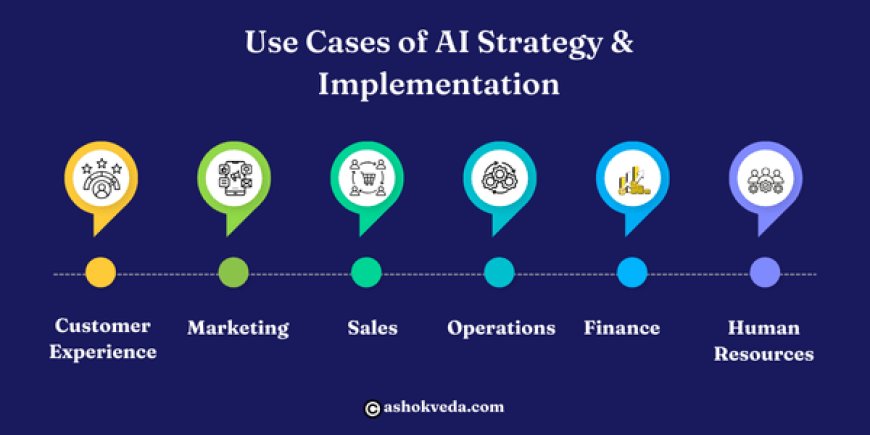
4. AI Strategy & Implementation in Operations
Operational efficiency is a major benefit of AI Strategy & Implementation. AI automates repetitive tasks and identifies inefficiencies in workflows.
Operational use cases include:
- Process automation and optimization
- Predictive maintenance for equipment
- Demand forecasting and inventory management
- Quality control through AI vision systems
Strategic planning ensures automation supports employees rather than replacing critical roles.
5. AI Strategy & Implementation in Finance
Finance departments rely on accuracy and compliance, making AI Strategy & Implementation especially valuable when governed properly.
Key finance use cases include:
- Fraud detection and risk analysis
- Automated financial reporting
- Expense and cost optimization
- Credit scoring and assessment
With ethical oversight, AI improves speed and accuracy in financial decision-making.
6. AI Strategy & Implementation in Human Resources
HR teams use AI to improve hiring, engagement, and workforce planning. AI strategy & implementation ensures fairness and transparency in people-related decisions.
HR use cases include:
- Resume screening and candidate matching
- Employee engagement analysis
- Workforce demand forecasting
- Learning and development personalization
Responsible AI practices help reduce bias and build employee trust.
Best Practices for Selecting AI Use Cases
Selecting the right use cases is critical to the success of AI strategy & implementation. Organizations often fail when they choose AI projects based on trends rather than business needs. A structured selection process ensures that AI delivers practical and measurable value.
To maximize value, organizations should:
- Align AI use cases with core business priorities and long-term goals
- Begin with pilot projects to test feasibility and reduce risk
- Confirm data availability, quality, and governance before deployment
- Include ethical, legal, and compliance checks from the start
- Measure outcomes using clear KPIs such as cost savings, efficiency, and user adoption
Following these practices strengthens AI strategy & implementation by reducing uncertainty, improving stakeholder confidence, and enabling scalable success.
Common Mistakes in AI Use Case Selection
Many organizations struggle with AI adoption because mistakes are made during the early stages of use case selection. Poor choices can limit impact and reduce trust in AI initiatives. Avoiding these issues is essential for effective AI strategy & implementation.
Organizations often fail when they:
- Choose AI use cases based on trends or hype instead of real business value
- Ignore data quality, availability, and readiness requirements
- Skip involvement from key stakeholders such as business leaders and end users
- Overlook the ethical, legal, and compliance implications of AI systems
Avoiding these mistakes improves long-term success by ensuring AI strategy & implementation is aligned with organizational goals, supported by reliable data, and accepted by users across the business.
Future Use Cases of AI Strategy & Implementation
As artificial intelligence continues to evolve, the scope of AI strategy & implementation will expand beyond today’s applications. Organizations will increasingly rely on AI systems that support complex decisions, improve collaboration, and operate with greater transparency. Preparing for these future use cases requires strong strategic foundations and responsible governance.
As AI evolves, future use cases will expand into:
- Autonomous decision-making systems that support faster business actions
- Advanced human-AI collaboration to enhance productivity and creativity
- Industry-specific AI platforms tailored to unique operational needs
- Explainable and transparent AI solutions that build trust and compliance
Organizations with a strong AI strategy & implementation foundation will adapt faster and remain competitive in the evolving digital industry.
The use cases of AI strategy & implementation demonstrate that AI delivers the greatest value when guided by clear goals, strong governance, and responsible execution. From customer experience and marketing to finance, operations, and healthcare, AI transforms how organizations work when applied strategically. By focusing on high-impact use cases, investing in data and skills, and maintaining ethical standards, organizations can turn AI into a scalable and trusted business capability. A well-executed AI strategy and implementation ensure that AI is not just a tool, but a long-term driver of innovation, efficiency, and competitive advantage.