




















Latest Research Shaping the Future of AI for Startups
Learn how the latest AI research empowers startups with advanced tools, faster development, ethical frameworks, and scalable tech that drives modern business growth.


Artificial Intelligence is experiencing a swift evolution, unlocking significant prospects for startups eager to innovate, expand, and compete on a global scale. The industry is growing at an unprecedented pace, with new models, frameworks, and research breakthroughs emerging every month. Understanding the latest research in AI for Startups is critical for founders who want to make informed decisions about product development, automation, customer experience, and operational efficiency.
In recent years, AI has shifted from a specialized enterprise tool to an accessible innovation driver for early-stage and mid-scale businesses. Startups now use AI to automate workflows, deliver personalized customer experiences, optimize logistics, improve decision-making, and develop software products powered by intelligent systems. To remain competitive, startups must stay aligned with the latest research in AI for Startups, especially in fields like generative AI, natural language processing, reinforcement learning, low-code AI development, and explainable AI. Current research not only accelerates innovation but also helps startups reduce costs, improve accuracy, and enhance product reliability. As AI continues to evolve, staying informed is no longer optional—it is a strategic advantage.
Latest research in AI for Startups
1. Advancements in Generative AI Research
Generative AI has become one of the most transformative technologies affecting startups. The latest research focuses on improving creativity, reducing hallucinations, and lowering computational requirements.
Key Innovations:
-
Small Language Models (SLMs): Research shows that compact models like Phi, Llama-3 Mini, and Mistral can perform efficiently on low-resource systems, helping startups implement AI without high infrastructure costs.
-
Multimodal Generation: New studies explore models capable of processing text, images, audio, and video together, enabling startups to build advanced applications like video automation, product design tools, and interactive chat agents.
-
Reduced Hallucinations: Researchers are developing factuality-enhanced training methods to improve accuracy in generative outputs, which is crucial for AI for Startups that operate in finance, healthcare, or legal tech.
How Startups Benefit:
-
Faster content creation
-
More affordable AI models
-
Improved reliability for customer-facing tools
2. Research in Explainable AI (XAI)
Trust and transparency have become leading priorities in AI research. Explainable AI focuses on making AI decisions easier to interpret and justify.
Recent Research Highlights:
-
Post-hoc explanation tools like LIME 2.0 and SHAP enhancements offer more precise visual explanations.
-
Research on glass-box models improves transparency by designing models that are interpretable by design.
-
Fairness research studies bias reduction strategies to ensure more ethical and balanced outputs.
Benefits for Startups:
-
Easier compliance with global AI regulations
-
More trust from investors and customers
-
Better debugging of ML models
Explainable AI is becoming an essential part of AI for Startups, especially in sectors involving sensitive data or automated decision-making.
3. Progress in Natural Language Processing (NLP)
NLP research is changing quickly as researchers build models that understand language more naturally and contextually.
Current Research Trends:
-
Instruction-tuned models that follow prompts more accurately
-
Long-context models capable of processing documents, reports, or logs up to millions of tokens
-
Domain-specific NLP models for healthcare, law, finance, and e-commerce
-
Emotion-aware conversational AI that interprets user tone and sentiment
Opportunities for Startups:
-
Customer support automation
-
Chatbots for sales and marketing
-
Content analysis and market insights
-
Automated documentation tools
Startups can leverage these research advancements to create personalized, context-aware AI products that engage users more effectively.
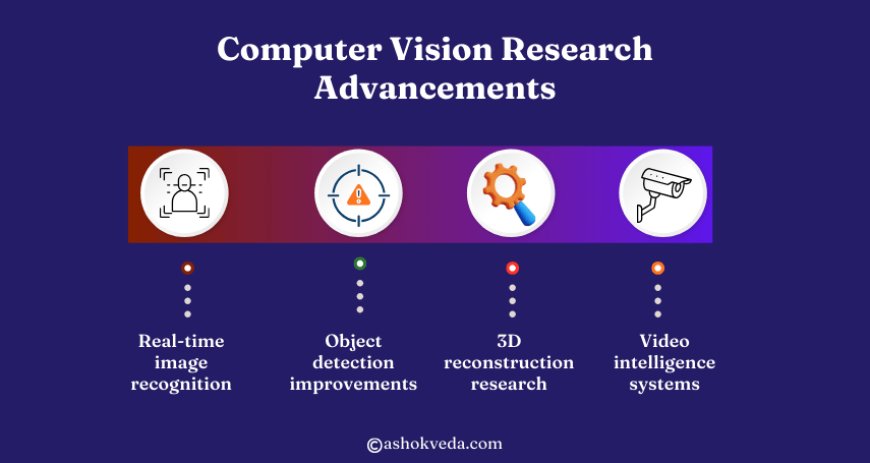
4. Computer Vision Research Advancements
Computer vision technology is becoming more accessible and powerful due to accelerated research in deep learning.
Latest Research Focus Areas:
-
Real-time image recognition using lightweight CNNs and Vision Transformers
-
Object detection improvements through YOLO-World and RT-DETR
-
3D reconstruction research helping startups build AR/VR applications
-
Video intelligence systems for surveillance, retail analytics, and content generation
Impact on Startups:
-
Reduced costs due to open-source CV libraries
-
Scalable vision systems for manufacturing, logistics, and retail
-
Accurate defect detection for quality assurance
-
Enhanced product features like image search or virtual try-ons
Computer vision research is particularly valuable for AI for Startups in physical industries.
5. Reinforcement Learning in Modern Research
Reinforcement learning (RL) is pushing boundaries in automation, robotics, and strategic decision-making.
Current Breakthroughs:
-
RLHF (Reinforcement Learning from Human Feedback) to enhance model alignment
-
Multi-agent RL for simulations involving multiple systems working together
-
RL for robotics making hardware automation more affordable
-
RL for optimization problems that help with supply chain, pricing, and recommendations
Startups Can Use RL For:
-
Logistics and route optimization
-
Personalized recommendation engines
-
Game-based simulations
-
Robotics and warehouse automation
Reinforcement learning research is powering some of the most sophisticated systems in AI for Startups.
6. Trends in Edge AI and On-Device Processing
New research aims to reduce the dependency on cloud computing by bringing AI closer to devices.
Recent Innovations:
-
Quantization techniques reducing model size without losing accuracy
-
Energy-efficient model design improving battery performance in devices
-
Federated learning research helping startups build AI that trains on user devices without storing data centrally
-
TinyML advancements enabling AI in wearables and IoT devices
Benefits for Startups:
-
Lower operational costs
-
Faster processing without cloud delays
-
Higher user privacy and security
-
Ability to deploy AI in offline environments
Edge AI aligns perfectly with privacy-first strategies essential in AI for Startups.
7. Latest Research in MLOps and Automation
MLOps research helps startups streamline the entire ML lifecycle—from development to deployment.
Emerging Areas in MLOps Research:
-
Automated training pipelines using AI agents
-
Self-healing models that retrain when performance drops
-
Model lineage tracking for transparency and auditing
-
AutoML advancements that reduce technical complexity
How Startups Benefit:
-
Faster deployment of AI features
-
Fewer engineering costs
-
Increased reliability of machine learning systems
Research in MLOps is becoming crucial for scaling AI for Startups efficiently.
8. Advances in Ethical AI Research
Ethical AI is now a central topic in modern AI research. Startups must build responsible systems to earn user trust.
Key Research Topics:
-
Bias reduction algorithms
-
Privacy-preserving techniques
-
Transparent datasets and labelling practices
-
Research-backed auditing frameworks
Importance for Startups:
-
Enhances trust and market acceptance
-
Avoids legal challenges
-
Supports sustainable long-term scaling
As regulations expand, ethical AI research will play a defining role in shaping AI for Startups.
The latest research in AI for Startups reveals a future where intelligent systems are more accessible, affordable, and powerful than ever before. Startups that understand and adopt these breakthroughs early will have a competitive edge in speed, innovation, and customer satisfaction. From generative AI to reinforcement learning, MLOps, NLP, and ethical AI, today's research provides actionable pathways for founders to build scalable, impactful AI-driven products. As the ecosystem continues to grow, staying informed about ongoing research is essential, not just to keep up but to lead.