























Key Data Requirements for AI for Startups Success
Learn the essential data requirements for AI for startups, including data quality, volume, security, governance, and best practices for scalable AI systems.


Artificial intelligence has become a powerful growth driver for modern startups. From automation and prediction to personalization and optimization, AI can transform how young businesses operate. However, the effectiveness of AI depends largely on one critical factor: data. Without the right data, even the most advanced algorithms fail to deliver meaningful results. This makes understanding data requirements essential for AI for startups.
Many startups rush into AI adoption without preparing their data infrastructure. This leads to inaccurate outputs, biased models, and low trust in AI systems. A clear understanding of data requirements ensures that AI solutions are reliable, scalable, and aligned with business goals. For startups seeking sustainable success, data readiness is not optional—it is foundational.
Why Data Matters in AI for Startups
AI systems learn patterns from data, making data quality, volume, and relevance essential for success. In AI for Startups, data goes beyond a technical input—it becomes a strategic resource that directly impacts performance, reliability, and growth. Well-prepared data enables AI models to generate accurate insights, automate decisions, and adapt to changing business needs.
Key reasons data is critical:
- AI models depend on both historical and real-time data
- High-quality data improves accuracy and decision-making
- Clean data minimizes errors, noise, and bias
- Strong data foundations support scalability and future expansion
Startups that prioritize data readiness early can fully leverage AI for startups, reduce implementation risks, and build sustainable, AI-driven solutions.
Core Data Requirements for AI for Startups
Not all data is equal. Startups must focus on collecting and managing the right types of data.
1. Relevant and Purpose-Driven Data
Data should directly support the AI use case.
Examples include:
- Customer behavior data for personalization
- Sales data for forecasting
- Support tickets for chatbots
- Transaction data for fraud detection
Purpose-driven data ensures that AI for Startups delivers practical value rather than generic insights.
2. Sufficient Data Volume
AI models need enough data to learn meaningful patterns.
Considerations include:
- More complex models require larger datasets
- Simple automation may work with smaller datasets
- Data should cover different scenarios and edge cases
Startups should balance ambition with data availability when designing AI for Startups solutions.
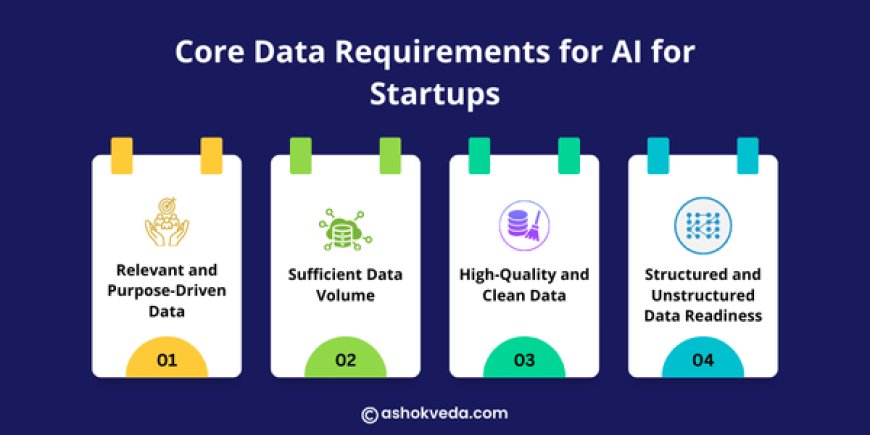
3. High-Quality and Clean Data
Quality matters more than quantity. Inconsistent or inaccurate data leads to unreliable AI results.
Data quality requirements include:
- Accuracy and completeness
- Consistent formats
- Removal of duplicates
- Minimal missing values
Clean data significantly improves the effectiveness of AI for Startups initiatives.
4. Structured and Unstructured Data Readiness
AI systems use both structured and unstructured data.
Structured data includes:
- Databases
- Spreadsheets
- CRM and ERP records
Unstructured data includes:
- Text
- Images
- Audio
- Video
Preparing both data types expands the capabilities of AI for Startups.
Data Collection Methods for AI for Startups
Effective data collection is the foundation of successful AI implementation. For AI for Startups, data must be gathered responsibly, efficiently, and in alignment with business goals. Choosing the right data sources helps startups build accurate models while maintaining user trust and regulatory compliance.
Common data sources include:
- Internal business systems such as CRM and ERP platforms
- Customer interactions across sales, support, and feedback channels
- Website and mobile app analytics track user behavior
- Third-party APIs providing market, financial, or behavioral data
- Public datasets for training and benchmarking AI models
Ethical and transparent data collection strengthens trust, ensures compliance, and supports sustainable growth in AI for Startups.
Data Labeling and Annotation Requirements
Supervised AI models rely on labeled data to learn patterns and make accurate predictions. In AI for Startups, data labeling means assigning clear, meaningful tags or categories to raw data such as text, images, audio, or numerical records. Well-annotated datasets directly influence model performance and reliability.
Labeling best practices include:
- Defining clear and detailed labeling guidelines
- Maintaining consistent annotation standards across datasets
- Conducting regular quality checks to reduce errors
- Involving domain experts for higher accuracy and relevance
Accurate and consistent labeling strengthens model learning, improves outcomes, and builds trustworthy AI systems for AI for Startups.
Data Storage and Infrastructure Needs
For AI systems to perform reliably, data must be stored securely and accessed efficiently. In AI for Startups, the right storage and infrastructure setup ensures smooth model training, deployment, and scalability as the business grows. A strong foundation also helps startups manage increasing data volumes without performance issues.
Key infrastructure requirements include:
- Scalable cloud storage to handle growing datasets
- Secure databases to protect sensitive information
- Backup and recovery systems to prevent data loss
- Controlled data access to ensure privacy and compliance
Robust data infrastructure enables stability, scalability, and long-term success in AI for Startups.
Data Security and Privacy Requirements
Trust plays a vital role in successful AI adoption. In AI for Startups, protecting sensitive user and business data is essential to maintain credibility and meet regulatory expectations. Strong security and privacy practices reduce risks and build long-term confidence in AI-driven solutions.
Security best practices include:
- Encryption of data at rest and during transmission
- Role-based access control to limit unauthorized usage
- Secure authentication mechanisms for systems and users
- Regular security audits to identify and address vulnerabilities
Privacy-first data handling not only ensures compliance but also strengthens user trust and adoption of AI for Startups.
Handling Data Bias and Fairness
Bias in training data can lead to unfair and inaccurate AI outcomes. For AI for Startups, managing bias is essential to building ethical, reliable, and trustworthy AI systems. Proactively addressing fairness helps startups avoid reputational risks and improve decision quality.
Bias mitigation strategies include:
- Collecting diverse and representative data samples
- Conducting regular bias testing and performance reviews
- Maintaining balanced datasets across user groups
- Implementing transparent and explainable decision logic
Fair data practices promote responsible innovation and ensure inclusive, ethical AI for Startups implementations.
Data Governance for AI for Startups
Data governance defines how data is collected, managed, and used across an organization. In AI for Startups, clear governance frameworks help maintain data quality, accountability, and compliance as AI systems scale. Well-defined governance reduces risks and improves decision-making.
Governance elements include:
- Clear data ownership and accountability across teams
- Standardized documentation for datasets and models
- Well-defined data access and usage policies
- Version control to track data and model changes
Strong data governance ensures consistency, transparency, and long-term reliability in AI for Startups operations.
Preparing Data for Model Training
Raw data cannot be used directly for AI model development and must be properly processed first. In AI for Startups, effective data preparation ensures models learn accurate patterns and deliver reliable results. Proper preprocessing also reduces training time and improves overall performance.
Preparation steps include:
- Data cleaning to remove errors, duplicates, and missing values
- Normalization to scale data consistently
- Feature engineering to extract meaningful variables
- Dataset splitting for training, validation, and testing
Well-prepared data increases accuracy, efficiency, and scalability in AI for Startups models.
Continuous Data Monitoring and Updates
AI systems are dynamic and require ongoing data maintenance to perform effectively. In AI for Startups, regularly updating and monitoring data helps models stay accurate as user behavior, markets, and conditions change. Continuous oversight prevents performance degradation over time.
Ongoing data practices include:
- Monitoring data quality to identify errors or inconsistencies
- Updating datasets with fresh and relevant information
- Detecting data drift that affects model predictions
- Retraining models to adapt to new patterns
Continuous improvement ensures AI for Startups solutions remains reliable, relevant, and high-performing.
Cost Considerations for Data in AI for Startups
Data preparation requires upfront investment, but it significantly reduces long-term costs and risks. In AI for Startups, well-managed data lowers operational inefficiencies and improves overall AI performance. Strategic spending on data readiness delivers measurable financial benefits.
Cost benefits include:
- Lower error rates, reducing costly corrections
- Reduced need for model rework and retraining
- Improved automation efficiency and productivity
- Better return on investment from AI systems
Investing in strong data foundations enhances performance, scalability, and the financial value of AI for Startups initiatives.
Future of Data Requirements in AI for Startups
As AI technologies continue to advance, data requirements will become more structured, automated, and efficient. In AI for Startups, automated data pipelines, smart labeling systems, and advanced governance tools will simplify data preparation and management. These innovations will reduce manual effort while improving consistency and accuracy. In the future, AI for Startups will increasingly depend on real-time, high-quality data as a core strategic asset. Startups that invest today in strong data foundations, scalable infrastructure, and governance frameworks will adapt faster, innovate smarter, and scale more effectively in an AI-driven marketplace.
AI success begins with data. Without relevant, clean, and secure information, AI initiatives struggle to deliver meaningful value. In AI for Startups, startups that understand and invest in strong data requirements are better positioned to build reliable, ethical, and scalable AI systems. For long-term growth, data is not just an input—it is a competitive advantage. By prioritizing robust data practices, AI for Startups becomes a powerful driver of innovation, user trust, and sustainable business success.